





Followed by a free BBQ at Al Rohrstaff's House
   |
|
This is a Michigan control line event jointly sponsored by the West Michigan Smoke Rings, the Broome park Circle Burners, and the Lansing Area Flying Aces. Our deepest gratitude to the Northern Virginia Control Line Club for the inspiration for this event which honors Walt Musciano, who for many of us, designed our first model airplane. The emphasis is on fun and nostalgia, not performance and competition.
Remember those one and two page Scientific spreads in the model magazines of the 50s, and 60s? Row after row of carved balsa fuselage, solid wing, semi-scale designs that barely fell within your nickel and dime budget? The purpose of this event is to let you go back to that simpler time, indulge your nostalgic bones to the maximum, and at the same time honor the man who designed most of those models - Walt Musciano. The rules are designed to keep within the spirit of that time. This event is meant to recapture the wonder of flight we experienced back then, and to savor it again after all these years. |
General Information • Events • Entry Fee • Acceptable Designs • Construction Requirements
Entry Requirements/Restrictions • Engine Requirements/Restrictions • Eligible Engines
Fuel • Lines • Pull Test • Participation Requirements • Scoring • Event Descriptions
Direction to the Air Zoo • Sources for Kits, Plans, & Engines
General Information
|
Pilot check-in at 0900 (9:00 AM) All events will be conducted in accordance with AMA regulations regarding control line models and the particular event being flown, except as is otherwise specified in these rules. All AMA Safety rules will be strictly enforced. Parts of aircraft that fall off during takeoff or during flight shall result in an attempt in Speed or Stunt and in forfeiture of the heat or final in Rat. Parts of aircraft that fall off during landing (or crashing) must be securely repaired/reattached before proceeding. Failure to do so shall result in an attempt in Speed or Stunt and in forfeiture of the heat or final in Rat. Such attempts and forfeited heats do not qualify for participation points. Other heats and attempts may still qualify the entrant for participation points however. (Per AMA rules) |
Events
|
Craftsmanship and Appearance Semi Scale Proto Speed Slow Rat Race Stunt (Modified) Biplane Event |
(Back to Top)
Entry Fee
| $20 first event, $5 for each additional event to a maximum of $30 |
(Back to Top)
Acceptable Designs
|
1) Must be 1/2A (.049) control line planes designed by Walt Musciano and kitted by Scientific (See list below). Plane does not need to be built from an original Scientific kit. Scratch-built and currently produced replica kits are acceptable. Regardless of source, the plane must meet all of the requirements listed in these rules. 2) Either single or twin-engine models are permissible. 3) Only carved fuselage, solid wing planes are permissible. No profiles. No fuselages built up from sheeting and bulkheads. 4) Only planes with exposed controls. No embedded or enclosed controls. |
Acceptable Design List
|
Aeronca Sedan
Air Champ Aircoupe * Army Racer Atomic X Beechcraft T-34 Beechcraft Bonanza Beechcraft 17 Boeing F4b-4 Boeing P-26a * British S.E. 5 Bullet Cessna 170 Cessna 172 Cessna 180 Cessna 182 Tricycle Cessna Bird Dog * Combat Master Curtis Hawk P6-E Curtiss Helldiver Cyclone Douglas B-66 Jet Bomber F-100 Super Sabre F-51 Mustang F7u Cutlass F-82 Twin Mustang F-94c Starfire * Flight Master * Fokker Triplane Ford Flivver Gee Bee Sportster * Golden Hawk * Grumman Avenger * Kellet Autogiro Litttle Mustang Little Ace |
* Little Bipe
* Little Devil * Little Mercury Little Mustang Little Sabre * Little Stinker (Pitts Special) Lucky Racer Messerschmitt (109) Monocoupe 90a Mr. Mulligan North American At-6 Texan P-40 Flying Tiger P-47 Thunderbolt Piper Comanche Piper Cub (Ambulance/Rescue) Piper Cub Cruiser Piper Cub Seaplane/Scout Piper Cub Special Piper Cub Trainer Piper Tri-Pacer Red Devil * Red Flash Ryan Pt-16 Trainer Snark Guided Missile Spirit Of St. Louis Stinson Reliant Stinson Voyager * Stitts Playboy Stuka Dive Bomber * Stunt Master Supersonic Missile Thunderbird Waco Cabin Yellow Bird * Zig Zag |
* Available as a Black Hawk Models kit
(Thanks to Jim Dodson and Currell Pattie for their help in building this list) (Back to Top)
Construction Requirements
|
In addition to the General specifications:
2) The size, outline, placement, and areas of the original design are to be maintained. This includes the Wing, Stab, Elevator, Rudder, Fin, Fuselage Side and Top views, etc. Cowls (or landing gear) if included on the plans, may be left off; but will be not be scored as high in the Appearance and Craftsmanship event as the same plane with a cowl (or landing gear) that is otherwise equal. Cowls (and landing gear) may be made removable and left off in the flying events and doing so will not forfeit Appearance and Craftsmanship placement awarded if they were in place for Appearance and Craftsmanship judging. 3) The fuselage must be carved from a block, or constructed of glued and carved slabs — no sheet and bulkhead or stick and tissue substitutions. Rounding and shaping of the fuselage must match original. 4) Wing must be of solid wood construction. Lightening holes are not permitted. Original outlines maintained. An airfoil is permissible at the builder's discretion. 5) Modern control systems, hinges, and adjustable leadouts are permitted. 6) Finish and markings are at the builder's discretion. Colorful, elaborate, multi-color, finishes are encouraged. |
(Back to Top)
Entry Requirements/Restrictions
|
1) A maximum of 3 different models may be entered (one for each event - Rat Race, Speed, and Stunt). Participants can practice with as many Planes as time allows, however once a plane is used for an attempt, an official, or in a heat, it is the entry for that event. Backup entries (planes) are not permitted. Repairs, if safe in the opinion of the Event Director, are permissible. 2) To qualify for the Craftsmanship/Appearance event, the plane must be entered and successfully flown in one of the “flying” events. See ‘Participation Requirements’ for the definition of "Successfully flown". |
(Back to Top)
Engine Requirements/Restrictions
|
The limited engine rule is intended to maintain the nostalgic spirit of the event, keep the performance comparable to vintage powerplants, provide for current availability, and provide a level field for competition.
2) Only engines from the ELIGIBLE ENGINES list are allowed. 3) Only stock parts (as delivered on the engine) are allowed except as otherwise permitted in the ELIGIBLE ENGINES list. 4) Simple fitting of the stock engine parts is permitted, but hop ups are not. Hop up examples include (but are not limited to) boring out the venturi, thinning the spray bar, opening up the bypasses, stuffing the crankcase, and so on. 5) Only suction, non-pressurized fuel systems are allowed. 6) Engines may be freely substituted on the plane between attempts, heats, officials, finals, etc. |
(Back to Top)
Eligible Engines
|
Atwood: Wasp .049 and all the .049 Atwoods. This includes the Original/Cadet and those Atwoods with colored heads, integral heads; and the Signature, Atwood Shriek, and Atwood Shriek Signature engines. The Cadet (clear) or earlier Signature (colored) heads may be used on the Shriek, if desired, so as to use standard ¼ x 32 short glow plugs. Fox: Fox Sport.049 (not the large case/intake F.A.I. model). Glow heads are unrestricted. Cox: Pee Wee .020, Space Bug Jr., Babe Bee, Golden Bee, Black Widow, and product engines sometimes called the Cox 290. Engines may be 2005 or earlier manufacture. Excluded are the Space Bug, Thermal Hopper, Space Hopper, RR1, TD, Venom, Killer Bee, and Texaco. Parts that fit may be freely interchanged, if desired, between the permitted Cox Engines. Not permitted are any engines, stock or otherwise, that have Killer Bee backplates, or that have TD, Texaco, Killer Bee, or Venom piston sleeve combinations, or other parts from anything other than the permitted engines. Glow heads are unrestricted. Holland: Wasp .049 only, not the Hornet. K&B: K&B Infant, Torpedo .035, Torpedo .049, and SkyFury .049. McCoy: Any McCoy .049, either Glow or Diesel. Also includes the plastic case Testors/McCoy engines. OK Cub: Any OK Cub .049 (or smaller), either Glow or Diesel. Spitfire: Baby Spitfire .045, Spitzy .045, and Royal Baby Spitfire .049. Testors: Copy of Wen Mac Hotshot/AMF Thunderbolt. Wen Mac: Any Wen Mac .049, including AMF copies. |
(Back to Top)
Fuel
|
Participants will supply their own fuel. |
(Back to Top)
Lines
|
1) Two lines required. 2) Recommended size: Steel stranded cable, minimum diameter “.008” for single engine aircraft. Steel stranded cable, minimum diameter “.012” for multiple engine aircraft with total displacement exceeding .049 cubic inches. Dacron lines are also acceptable. Line type is at the flyers discretion. All lines must pass pull test. 3) Line Length: 35 ft. from bellcrank to handle, + 6”, - 0" tolerance. |
(Back to Top)
Pull Test
|
1) Pull test will be 5 lbs for aircraft of .049 or less total displacement. 2) Pull test will be 10 lbs for multiple engine models with a total displacement greater than .049. 3) The Pull test is required for every model entered in an event. 4) At the Event Directors discretion a pull test may be required after crash repairs before being allowed to continue. |
(Back to Top)
Participation Requirements
|
No participation points are awarded in the flying events without meeting the minimum participation requirements. The minimum participation requirements for the flying events require the entrant to successfully fly at least one lap and additionally, in the opinion of the Event Director, at least tried to successfully fly the event. The opinion of the Event Director (ED) is final and is not subject to appeal. Participants who fly aircraft built by others will be awarded any and all prizes. No proxy flying will be allowed. This last point is to encourage on-site participation. |
(Back to Top)
SCORING
|
1) See Event Descriptions for information about specific events.
2) Placement points are awarded for each event (Stunt, Speed, Rat Race and Appearance) as follows: 3) Participation points (3 points) are awarded to each participant who does not place 1st, 2nd, or 3rd in an event (Stunt, Speed, Rat Race and Appearance) but who meets the minimum participation requirements for that event. 4) Overall placement is the sum of the above points. 5) Kids (flyers under age 12) will participate in all events along with everyone else. However, their scores will be tallied separately from adult participants and will be awarded separate 1st, 2nd, and 3rd place awards. |
(Back to Top)
Event Descriptions
|
CRAFTSMANSHIP & APPEARANCE 1) Entries will be judged based on appearance and workmanship prior to the start of the flying events. 2) CRAFTSMANSHIP & APPEARANCE judging will be by the CD or his designee. 3) Each modeler will put his name on a tag/card with his entry. 4) Entry must be a completed plane, with engine, ready to fly. 5) Entry must be successfully flown in one of the flying events (Stunt, Speed, or Rat Race) or complete a 10 lap demonstration flight. Failure to successfully fly will result will result in forfeiture of CRAFTMANSHIP & APPEARANCE points and prizes which will then be awarded to the next best placing CRAFTMANSHIP & APPEARANCE entry. SEMI SCALE 1) Entries will be judged based on appearance and workmanship prior to the start of the flying events. 2) SEMI SCALE judging will be by the CD or his designee. 3) Each modeler will put his name on a tag/card with his entry. 4) Entry must be a completed plane, with engine, ready to fly. 5) Entry must be one of the semi scale hollow log designs. 6) Entry must be successfully flown in one of the flying events (Stunt, Speed, or Rat Race) or complete a 10 lap demonstration flight. Failure to successfully fly will result will result in forfeiture of SEMI SCALE points and prizes which will then be awarded to the next best placing SEMI SCALE entry. PROTO SPEED 1) Four attempts (total) will be allowed for two official flights. Note: this is not the same as four attempts for each of two officials. Be sure you understand the difference. 2) Score will be based on the best speed/lowest time of the two official flights. 3) The slower of the two official flights will be used as the first tiebreaker. The most laps completed in an attempt is the next tiebreaker. A fly off will be used as the final tiebreaker. 4) The contestant has three minutes to enter the circle, start the engine, and launch. 5) Models may be hand launched or ROG from prepared surface at the competitor’s discretion. 6) Models will be timed from the first pass over the start line until completion of 12 laps (1/2) mile. 7) Maximum flying height is 20 ft. 8) Electric starters may be used. 9) AMA CL Speed and CL general attempt definitions apply except as listed here. Failure to launch in 3 minutes is an attempt. Failure to complete required laps is an attempt. Failure to get or remain airborne after launch is an attempt regardless of how little distance traversed/flown and/or regardless of whether or not the 3 minutes is up. 10) Successful launching and completing the 12 laps constitutes an official flight. Flying high may, at the discretion of the Event Director, constitute a no-score official. Note: a no-score official is not as severe as disqualification. (Disqualification, as a minimum, throws you out of the event as commonly interpreted by AMA CDs, and a literal reading of the AMA rulebook requires throwing the entrant out of the contest.) 11) Deliberate crashing, in the opinion of the event director, to avoid an official flight, will constitute a no-score official. SLOW RAT RACE 1) Models will be flown in a series of heat races leading to a final race 2) Races will consist of two or three models. 3) Each contestant will fly two heat races. The best (lowest) time from the two heat races will determine each contestant’s score. 4) The three entrants with the best heat scores will fly a final race. If there are eight or more entrants, the four with the best heat scores will go into the finals. 5) Ties will be broken, if necessary to get into the finals, by using the other heat scores, else most laps completed for the other heat, else a flyoff heat. 6) Final standing will be determined by the time required to complete the main event final race, then laps completed if not everyone completes the finals. Finals ties will be broken by best heat scores. Best heat score ties will be resolved as described in item 5 above. 7) Races will begin with all engines stopped. At the starting signal, engines will be started, and the models may be launched as soon as the models/pit crew/pilots are ready. 8) Timing will begin at the starting signal and continue until the model has completed the required number of laps, and pit stops, for the race being flown. 9) In the heat races, 30 laps (1.25 miles) and one pit stop is required. In the final race, 60 laps (2.5 miles) and two pit stops are required. 10) Landings, or crashes, with the engine running will not be counted as a pit stop. 11) At each pit stop, the model will land, be refueled, the engine restarted, and the model launched to continue the race. 12) Models may be hand launched or ROG 13) If the required pit stops have not been accomplished before the required number of laps is completed, timing will continue until the model has completed one full lap following the last required pit stop. 14) Each contestant may act as either the pilot or as the pit crew who starts the engine and launches the plane. Points scored will go to the individual who entered the plane in the event. 15) Specific requirements for conduct of pilot and pit crew will be discussed on the day of the race. All requirements are as specified in the CL Racing Unified Rules in the AMA rulebook except as otherwise modified here. 16) A person who causes a line tangle/midair/crash of someone else’s plane is to forfeit the heat or final. The CD or ED is to determine to the best of their ability the responsible person. The remaining persons in the heat or final get to refly the heat or final. If it was a final, the next best person from the heats gets to advance to the final for the refly. If it was a heat the CD or ED may replace the person who forfeited the heat and reschedule the heat. A forfeited heat has no score, counts as a heat, and does not qualify for participation points. The CD’s or ED’s opinion is final and is not subject to appeal. (Per the AMA rules) 17) The ED may require any entrant to prove he is capable of flying in a multi flyer event before being permitted to do so. The ED is expected to require such demonstrations to ensure the safety of all when he suspects such inability. An ED should not allow persons who have demonstrated (either in a requested demonstration or in an actual heat) that they are incapable of flying in a multi person event to do so. Such persons may still serve as the pit crew for their entry. The ED’s opinion is final and is not subject to appeal. (Per the AMA rules) 18) Fast fills, hot gloves, hot fingers, pressurized refueling systems, and similar devices intended to decrease pit stop times are prohibited. Electric starters and 1/2A spring starters, mounted on the engine, are permitted. 19) Two timers/lap counters will be used for each plane flown in a race unless the CD determines there are only enough people available for one each. 20) Attempts, in the usual sense, do not apply to racing events. Each contestant gets one chance to complete each heat or the finals. If completed a time will be recorded, else a "DNF" and the number of laps will be recorded. "DNF - 0 laps" is a possible score. 21) If an entry is not started and launched within 2 minutes after the race starts for the heats, and within 4 minutes after the race starts for the finals, a "DNF - 0 laps" is scored for that entry. MODIFIED STUNT EVENT Scoring, attempts, conduct, rules, responsibilities, everything, will be exactly like AMA precision aerobatics except as is otherwise defined here. As these planes are old designs, the maneuvers are somewhat like old time stunt. There are also a couple of optional "tiebreaker" maneuvers. 1) One level lap will be flown between maneuvers. 2) There is no penalty for running out of fuel once. Simply refuel and continue where you left off. The CD may, at his discretion, allow running out of fuel twice or three times provided that time permits. This decision will be made and announced prior to the start of the event. 3) Launch will be ROG from prepared takeoff area, or hand launched, at the competitor’s discretion. 4) Electric starters may be used. 5) Three attempts (total) will be allowed for two official flights. Note: this is not the same as three attempts for each of two officials. Be sure you understand the difference 6) Stunt scoring is by maneuver. Higher is better. Your score for each official flight is based on the sum of your points for each maneuver. Your placing for the stunt event is based on your best offic1al flight. The maneuvers and their point ranges are listed below: Starting and launch within three minutes 0 or 5 points Launch and level flight (2 laps) 10 - 40 points Wingover (not reverse) 10 - 40 points Climb and dive (Like old time stunt - steep climb, one lap high, dive back to level at same place climb was initiated) 10 - 40 points Two inside loops 10 - 40 points Approach and landing 10 - 40 points
Optional Maneuvers
If modeler wants to attempt to gain additional points, tell the judges before you fly and include these after the inside loops. One outside loop 10 - 40 points Two lazy 8’s 10 - 40 points BIPLANE EVENT GENERAL: This event is designed to encourage the entry of Walt's many biplane designs. ELIGIBLE DESIGNS: Any walt Musciano designed Scientific hollow log biplanes:.
COMPETITION: This event will be run as either a timed speed run or a modified stunt event using the rules outlined for the Proto Speed and Modified Stunt events.
(These rules were created by the Northern Virginia Control Line club and are presented here in a slightly modified version. A big thank you to this great group for creating this idea and bringing it to reality – RJK) |
(Back to Top)
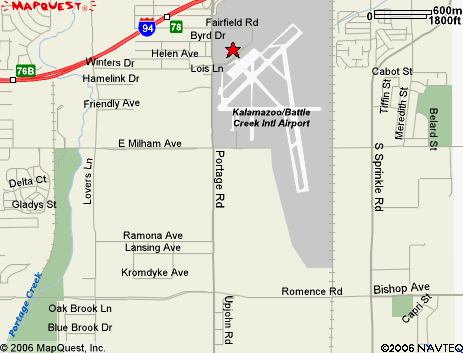
Directions to the Air Zoo
| The Air Zoo is off I-94 Exit 78, 1 mile South on Portage Road, just past Milham Road. Look for Air Zoo Entrance on left. (East side of Portage Road). Signs will direct you to the Fun Fly. |
(Back to Top)
Sources for Kits, Plans, and Engines
|
Black Hawk Model Kits are available from the following sources: |
(Back to Top)
(Edited by: Rich Kacmarsky - June 2010)